
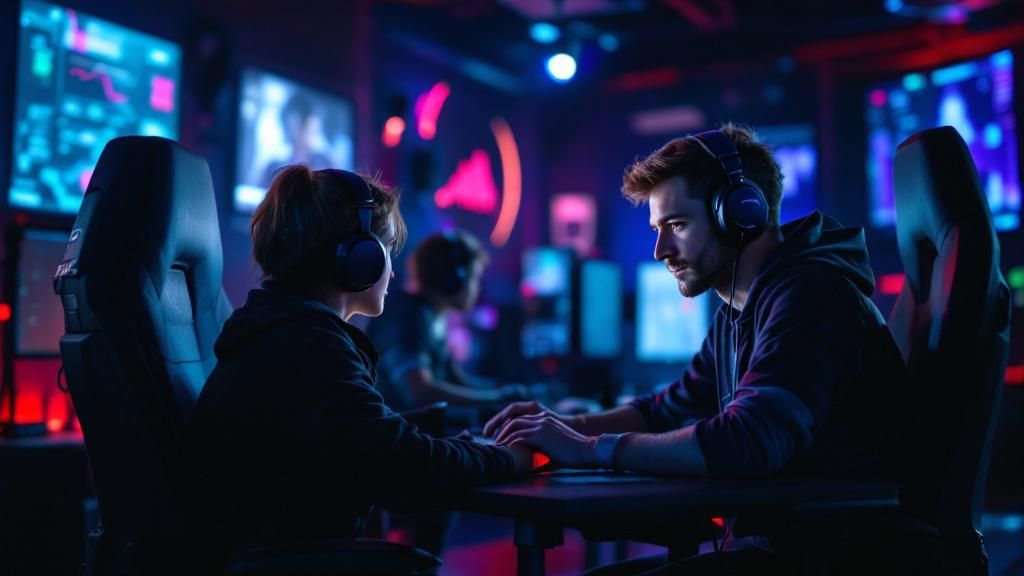
The esports coaching industry is undergoing significant growth, transforming competitive gaming into a sophisticated, data-driven discipline. As professional teams invest heavily in dedicated coaching personnel, advanced performance analytics and strategic advancement have become essential components of success. This article investigates how state-of-the-art systems and performance measurement systems are reshaping coaching methods, team dynamics, and tournament results, whilst assessing the widening career opportunities within this fast-growing field and the essential position coaches now play in developing elite players.
The Rise of Professional Esports Coaching
The esports coaching industry has undergone a remarkable transformation over the past decade, evolving from informal mentorship to a structured, professionalised discipline. As competitive gaming has matured into a multi-billion-pound industry, organisations have recognised the critical importance of dedicated coaching staff. Professional teams now employ specialised coaches who focus on player improvement and progression, strategic gameplay, and group unity. This professionalisation has legitimised esports coaching as a viable career path, drawing in experienced professionals from conventional sporting and gaming sectors alike.
The primary reason for this accelerated expansion lies in the increasing complexity of current esports franchises and the elevated degree of competition at professional levels. Teams taking part in major championships face opponents who possess equivalent mechanical prowess and competitive expertise, making the margin between winning and losing often shaped by advanced coaching and comprehensive planning. Resources dedicated to coaching systems has evolved into a critical need rather than a luxury, with teams dedicating substantial budgets towards building comprehensive coaching departments. This transformation has profoundly reshaped how players train and develop, cementing coaching as an indispensable element of competitive achievement.
Operational Analytics and Data-Informed Approaches
Modern esports coaching has fundamentally changed through the incorporation of advanced analytical tools and evidence-based approaches. Coaches now leverage detailed performance records covering player statistics, game metrics, and conduct trends to shape strategic decisions. This data-focused method permits teams to spot advantages, identify deficiencies, and create focused development plans. The move to quantifiable performance measurement has raised coaching standards from intuitive guidance to data-informed methodology, significantly enhancing competitive outcomes and performance improvement journeys across professional esports organisations.
Instant Performance Monitoring
Immediate performance monitoring systems give coaches with instantaneous understanding into athlete movement patterns, tactical choices, and physical reactions throughout competitive matches. These advanced platforms track reaction times, precision rates, positioning efficiency, and tactical awareness metrics. Coaches can review data streams in real-time during gameplay, allowing for instant guidance and in-match adjustments. This real-time analytical capability enables teams to spot developing trends, exploit opposition vulnerabilities, and optimise athlete output in key situations, fundamentally enhancing in-game strategic execution and competitive advantage.
Integration of biometric sensors and eye-tracking technology has further enhanced live tracking functions within esports training facilities. These cutting-edge systems evaluate concentration levels, stress indicators, and visual focus patterns, providing comprehensive insights into player cognitive and physical states. Coaches leverage these measurements to identify performance variations, optimise training schedules, and build psychological strength approaches. The integration of performance data and biometric information creates holistic performance profiles, enabling personalised coaching interventions that address both technical and psychological aspects of competitive esports performance.
Strategic Analysis Tools for Gaming
Specialised game analysis software enables coaches to deconstruct opponent strategies, identify tactical tendencies, and develop counter-strategies with remarkable accuracy. These systems capture extensive match footage, mark up critical instances, and produce comparative analytics across various matches and opposition teams. Coaches employ replay systems with frame-by-frame analysis capabilities to assess player positioning, ability deployment, and tactical decision patterns. This detailed analytical approach facilitates comprehensive strategic preparation, allowing teams to anticipate opponent patterns and develop tailored tactical frameworks that maximise competitive probability and team performance outcomes.
Sophisticated AI systems and machine learning algorithms now drive modern competitive analysis platforms, streamlining pattern identification and forecasting capabilities. These systems identify effective tactical sequences, resource allocation strategies, and map-specific tactics by examining thousands of professional matches. Coaches utilise AI-generated insights to assess team capabilities against top-tier organisations, recognise capability shortfalls, and prioritise training focus areas. This technological integration broadens availability to sophisticated strategic analysis, enabling smaller organisations to perform competitively against dominant organisations through data-informed coaching methodologies and evidence-based strategic development.
Upcoming Opportunities and Sector Growth
The esports coaching industry is primed for significant expansion over the next years, driven by increasing investment from leading organisations and media networks. As competitive gaming maintains its mainstream recognition, demand for experienced coaching professionals will accelerate significantly. Academic bodies are starting to create dedicated esports programmes, building structured pathways for aspiring coaches. Furthermore, technological advancements in artificial intelligence and machine learning promise to deliver even more refined analytical capabilities, allowing coaches to identify deeper insights from performance data and enhance strategic approaches with exceptional detail.
International markets offer considerable opportunities for sector expansion, particularly in regions where esports infrastructure stays underdeveloped. Growth markets are actively creating professional gaming scenes, driving demand for seasoned coaching skills and mentorship. Commercial and collaborative opportunities are broadening beyond traditional gaming companies, with major companies acknowledging esports’ commercial potential. As professional standards advance across all competitive titles, coaching salaries and career stability will increase significantly. This development will draw elite professionals to the sector, ultimately enhancing coaching standards and cementing esports as a credible, valued career within the broader sports and entertainment landscape.
